Dienstag, 26. September 2017

Nikon D850 Review (sort of)

Nikon D850 and the new guitar problem


I had the chance to play with the new Nikon D850 very early (30.8.2017) and could also work with raw files thanks to Raw Therapee. To make it short, the file quality is really very good, nothing to complain about. But on the other hand also nothing to get too excited, as the files of my beaten D800 are more than good enough still for 99% of my work. Even the files of the D750 are perfect most of the time.
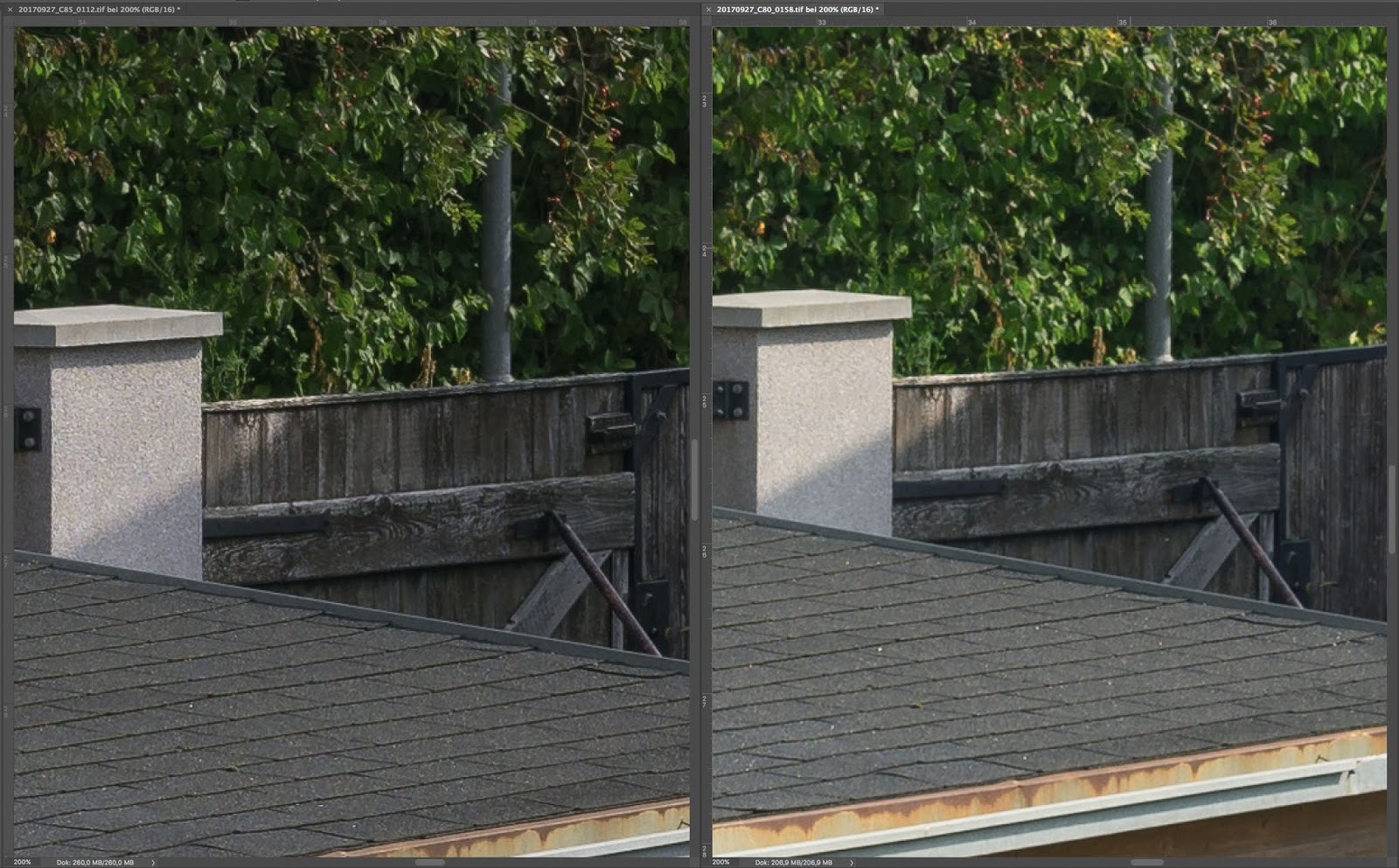

Warning!-this is pixel peeping at 200%
Both pictures are made with the Nikon 50 mm f1,8 lens @f8 from tripod and with mirror up. Left D850 with Iso 64 and electronic first curtain, right Nikon D800 with Iso 100. There is a small difference in resolution and dynamic range. With a zoom lens like the 24-120 it is less or not visible at all, with a "better" lens there might be a bigger difference (I do not own an Otus lens).

So why upgrade at all? I already skipped the D810, although I got occasionally mild G.A.S. symptons the last years.
It is an investment of at least 4000.-€ (incl. tax here in Europe) as you have to buy a XQD card and a card reader up front with this camera. I even tried to argue me off this purchase. I failed, because a week ago I strolled through a town here in Lower Austria. To my astonishment one of the photo shops had the D850 on display. And when I phoned them three days later the camera was still available, so I bought it. Seems like here in Austria not so many photographers want to spend 4000.-€, because the shops here don't get larger quantities than in the USA.
What tipped me over was not a technical feature, like the good viewfinder, better AF or more megapixel. It was realising that the attitude of „ I do not need this, it does not matter which camera I use, any will do“, has a psychological problem. Yes, for most of my projects 24 Mp will be more than enough and yes most of my customers wont see any difference with the pictures no matter what camera I use. If any one out there thinks he gets more revenue, more customers with a new digital camera, think twice.
But with photography it is also like with music, you do not do it just for making money, you also are linked to this art or craft, because for making money even a job as a house cleaner would be better. If I would look at what I earn per hour, I would kick myself. But photography is the only thing which keeps me going, which is kicking my butt saying „get up, get out, get some pictures“.
Buying such a camera is for me a way to take my laziness out of me. It forces me to make new projects, because buying such a camera and then just making a few snapshots – no way!
So here are some excuses I found so far to purchase it nevertheless:

The live view stream has a better resolution, it was 640 pixels and is now 1024 pixels to match the higher magnification of the rear screen, which helps if you do studio work and use camera control pro, or the rear screen and a magnification loupe. The split screen function is helpfull, but at Nikon nobody seems to use the Tilt/Shift lenses, because it is still not possible to look at the upper left and lower right corner in split screen mode at the same time.
For checking sharpness when you use the tilt of a lens like the 45mm TS the new focus peaking function helps.
One good thing though is that now the 24mm TS lens rotates in both directions. With the D800/810 it was blocked by the bigger viewfinder/flash combo.


the less protruding viewfinder allows full rotation with the 24 mm TS lens

The screen is now tiltable, ok that´s good (I like and use the tiltable screen of the D750 often), but anyone taking vertical pictures at Nikon? Fuji is that doing right with the Xt-2.

The illuminated buttons are nice to have, but only at the the left row. On the other hand even at night photography I still need a red led lamp to see my surrounding or find pieces of equipment in my bag.
The better AF and speed is also a big improvement to my D800, I am looking forward to use that on my next trip to Africa. But for the 9 frames/sec there is the need of further investment in grip, battery and charger. Maybe the D500 might be the better investment for action or sport. Yes the D850 might be the best "allround camera" which can do anything from birds in flight to landscape or architecture. But there are situations where changing lenses (often) is not such a good thing to do and also a second body on longer trips is a wise thing to pack into your camera bag. So this D850 is not the "all in one solution" you might think. Also only the best lenses shine on the D850, this is certainly also the case with long telephoto lenses. So paired with a 600 mm f4 you get a dream team up to the moment you take your gear on board of an aircraft. Can you manage the 8kg weight restrictions or do you buy a second seat?

If you want to make the best of this AF you have a steep learning curve up front. I can recomend „Secrets of the Nikon AF System“ from Steve Perry. This pdf has 467 pages! So much about digital makes photography easier.
He has also a good video about the new AF fine tune feature. Which gets things into perspective fast, because he shows that you should do 12 readings to get a good average number. And you must center in Live View the AF point, otherwise a cryptic Text shows up. It took me more than half hour to find that I accidently switched the AF point in live view a little bit. The fine tune numbers where sometimes quite consistent, with other lenses like the Tokina Makro the readings were more erratic, but at least it did not refuse to take a third party lens. Af fine tune with one click? Sadly no!

Now checking the fine tune with a real furry animal, a teddy bear. What I found I did not like, because the numbers for my 300 mm f2,8 lens were simply said garbage. With the 1,4 Tc I had -17, but testing it with different numbers the best one was 0, or af fine tune set to "off". Seems like the af fine tune feature is very prone to (user) error.


Silent shooting mode sounded great for me, but it is only available in live view mode. So that means shooting with a 3800.-€ camera similar to a smartphone (or as someone stated, you hold the camera away from you like a smelly diaper). While you can adapt the viewfinder (diopter adjustment) to your (poor) eyesight, not so for the rear screen, which means you might need your glasses on and I am still not sure if live view AF is useable in a dark church? But the screen with the better resolution is really a big step forward and the touch screen feature is great! Now all the menus are touch sensitive, which is a good thing and speeds navigating in the menu. Certainly scrolling through pictures is also much faster.
I was also very interested in the so called „Best optical Viewfinder ever“ of the D850.
It is bright and certainly better than the one in the D750, but as numbers suggest: magnification of D810 is 0,70 with eyepoint 17 mm, the D850 has increased that to 0,75 with also 17 mm eyepoint. Hey, great, an increase of 0,05! Did Nikon really want to make the best optical viewfinder or did they reduce cost by skipping the flash? I used the on board flash quite often for remote control of macro flash. With the D850 I will need a commander module or dedicated flashes=extra weight to carry.
I am beyond 50 and get more and more problems with my eyesight, certainly a big bright viewfinder helps. But also the size of the letters in the viewfinder and the menu is interesting. Here nothing has changed, but it was quite useable before.

Automated stacked shots for macro looks good on paper, but with the app „helicon remote“ or even more versatile „qdslr-dashboard“ this was possible with every Nikon Camera which had open Wifi. See the problem, the snap bridge bluetooth/Wifi of the new Nikons is not allowing 3rd party apps to function like before, its a more closed system with very poor functionality.
Also to my big disappointment this feature does not work with the Nikon 200 mm f4 Macro lens or my Tokina 100 mm f2,8 Macro, only AF-S or AF-P lenses are supported. When I tried it manually I encountered a problem with snap bridge (surprise?), in Live view there is no focus peaking on the smartphone, live view on camera and releasing the shutter on the snap bridge app does also not work. So back to the good old cable release! Silent shutter does work, but without flash, it wont fire. 
I tried a stacked shot with 30 frames. I use a mac book pro retina with 16 GB Ram and 2,8 Ghz quad processor. Such a task takes this computer to his limits, but he managed to do it. So I do not think that this camera will force me to buy a new computer, but it slows some tasks down like panoramas or stacked shots.


64 ISO, F8, 1/40 sec
A stack of 30 frames, manual mode with a Oben macro slider and the 100 mm f2,8 macro from Tokina. Silent shutter "1" shutter release via snap bridge app. Working very accurate would be good, as the processing on the computer took about 30 minutes. Every mistake means back to the start. Here I missed the opportunity to use the 4:5 Raw file option, which would have reduced file size. No need to record more of the black area.

Update 9.10.2017:
The time lapse features I have checked at the weekend. It works good and the combination of silent shutter is a good thing. But because of the massive file sizes I will still use my D750 or even my Coolpix A for occasional time lapse recording. And it also makes me nervous to put a 5000.-€ Camera/lens combo alone out in the field. But the same here like with stacked shots. Good if you are satisfied with the onboard tools, bad if you want to do your own thing, because snap bridge again limits this. The electronic shutter is certainly a good idea, because with heavy use of timelapse you can get beyond the limit of the mechanical shutter.

When I buy a new camera one of the first tasks is to test it with all my lenses. I have to do this anyway once a year to check for any problems. This time I found my 16-35 mm f4 lens to underexpose 1 stop, a cheap repair at Nikon fixed the problem. What astonished me was that wide angle lenses like the 14-24 are much better in the corners on the D850 than on my D800 (all settings equal and shooting from a tripod). I have no explanation for this, but I take it as a bonus of the new sensor right now.


this is the left side of the picture, in the center both pictures look identical sharp and focus point was also the same, checked it a second time with similar results.

Today, 19.10.2017 Lightroom is supporting the D850. Before I downloaded the files into the dng format via Adobe Bridge. The dng files are about 10 MB per file smaller than the original losless compressed nef 14 bit and I can not see a difference in file quality so far. But it was a workaround and in the long run I prefer the original Nef files over the Adobe dng format. For comparing other Raw converters the Nef file is preferred. A side note: I tested Capture One and the files do have more "punch",  but not because of some secret sauce. there are different profiles used, in C1 something more like a landscape profile, at Adobe the standard Profile is more flat. If you use the landscape profile in LR you get quite similar results to C1. And as a DAM Lightroom is still way better than C1. Changing software is like changing camera brands: Think twice about it. But testing C1 was actually a good idea, the different look brought new ideas which I now use with pictures in LR. 


20 mm f1,8 @ f16, pulled out of a single shot, so no HDR

And now to the „new guitar problem“:

Take a side step and imagine you are a musician, a guitar player. You have a decent model of an electric guitar. Now you have an offer for a guitar used and played by Eric Clapton, or a new model with fantastic new whatever advertised. Guess what, is there a guitar player out there who thinks he will be a better player just with a new guitar? Yes, there will be a lot of them, although they know that practising is way more important. Some even stated that talent is overrated, because someone who is practising like hell will beat the talented any time.


Disclaimer: I am not payed by anyone, so I can write freely what I like and what I do not like. And this is not a bashing of the D850, Nikon, or anyone out there. There are simply always things to find which work not as good as advertised. But after using the camera now for three weeks I can say it is the best camera I have ever owned
.
lots of light and conversion to black and white, no problem here for the D850. To be honest, the D750 would make a similar good picture. And who needs 45 MP for Facebook?


Tested the D850 at a local concert of the band "Monti Beton". This picture is made with 11400 ISO and turned out quite useable. The problem is that the modern LED lights on stage can have a "problematic" spectrum which leads to color artifacts. 

Sonntag, 24. September 2017

Yongnuo YN-685-Nikon: You get what you pay for

Up front, I like the simple manual Yongnuo flashes because of their reliable radio trigger, that gives me a lot of freedom and a simple solution to light up areas. My Elinchrom flashes are much more powerful, but also a lot heavier and need a power supply, so a lot of work to do. Often 4-6 Yongnuo flashes will be enough like the example below of a wooden ceiling in a church shows.


In such a setup I did not use my Nikon Sb-900 very often because I can not control their output like the Yongnuo flashes. The CLS System from Nikon is not alternative to me as it is ir-flash based and very unreliable, only working well in short distances, like with the macro flash Sr-200.

So I sold my two SB-900 and bought two YN-685 instead. These flashes are TTL- flashes and have also a radio receiver built in. Sadly after a few uses I got into problems. First the flashes seem to have a connection problem, often they do not get the information from the camera properly via the hot shoe. So they will fire, but with wrong output and the zoom reflector does not correspond to the lens. 
As a radio slave they work without problems and also as manual flash. But for that purpose I have the cheaper YN-560-III

So if you want TTL flash for Nikon look somewhere else. Metz flashes might be a good alternative or the Nikon SB-700 is not too expensive. 
See also the picture below about the poor quality of the battery compartment of the YN-685, which wont close properly after a few uses.


There is a newer firmware out there, but updating is avery complex procedure and you need a YN622C-TX trigger to do this. 

Donnerstag, 11. Mai 2017

Why the M/A to M switch on Nikon lenses sucks

Actually it not only sucks, it can be a cause of disaster.

For those many Nikon shooters who use BBAF (Back Button Autofocus) this switch on most of the Nikon lenses is meaningless. For others it might be usefull, as on the smaller Nikon Bodys you have to disable AF in the Menu, not having an AF Switch on the Camera (like D750). But wait, even then you can make a manuall override. Half press the shutter, focus manually (override the AF) and you are done. But for the next picture you have to do this again. 

Every button or switch can be useful or can work against you, it depends. What happened to me was that my 35 mm f1,8 AF-s lens was set accidently to M on this switch. Taking pictures in a quite dark church of people celebrating with f2,2 at 1/80 sec and 3200 ISO does not leave much room for "better" f stops. I was concentrating on the people, the lens was in M mode and at about infinity distance, the people were at 4-5 m distance. That meant that I was not able to see in the viewfinder that the lens was set to the wrong distance (this shocked me more afterwards than the fact that I made a technical mistake). 

Certainly the Af confirmation beep was set to "off" in the church. Yes the AF circle/triangle in the Viewfinder should be a warning, but it is tiny, very easy to forget about it in the heat of the action.
So my solution is: Tape this damned switch and forget it.
And if you have not tried BBAF - do it, it is very usefull.

Dienstag, 12. Januar 2016

Really Right Stuff Tripods - Best tripods ever?

Many photographers who take their craft or hobby serious sooner or later have to decide which tripod to buy. Even with insanly high Iso values in modern cameras beyond the million mark a tripod is still the dirty little secret for sucessfull photography. Yes you can make pictures in dimm lit areas without a tripod now, but the picture quality will always be worse than with base Iso. Especially in landscape photography you normally seek for optimal sharpness, so no camera shake, no grain from high Iso and also and often forgotten: maximum depth of field. You need to stop the lens down to get that and also to get sharp corners, almost no lens is good wide open. An one sec exposure with f11 at 100 Iso is common in a forest for example, at day not at dawn or dusk!


also for "selfies" a tripod can be useful (South Iceland)

I have used a lot of tripods in my 30+ years as a photographer. From cheap Slik aluminium tripods as a student to Manfrotto (Bogen) and to Gitzo. 
The Gitzo Carbon Fiber was a disappointment, after a year a leg fell off because the plastic slider inside was broken. I did get repair parts fast, but the construction itself whith cheap plastic inside is certainly not what you would expect from such an expensive tripod. So I sold it and do not recomend them.

An article from Luminious Landscape brought me to the tripods of Really Right Stuff. I knew them for their excellent arca swiss style L-Clamps. So I bought the TVC 34L with L for Large as it has a height of 174 cm and a TVC 33 with a height of 149 cm.
These heights are without central columns which these tripods do not have. And this is a good thing, a central column is almost useless, as it is unstable from the beginning.
With prices around 1000.-$ these tripods are no bargains at all. But are the worth it? So far with good use over the last few years the worked well with almost no issues. But the are not perfect. First I hade to use Loctite 243 to get the leg screws permanently fixed in that position I wanted them, otherwise the come loose over time. But this is a common problem with all tripods and RRS replied to me that they do not fix that themselves so that the photographer can adjust the stiffness of the legs to their needs - Ok that makes sense in a way, but they could supply for that price a small bottle of Loctite 243 with instructions how to use that.

The other thing I do not like are the rubber feet at the bottom, very big and broad, so maybe good on Sand, but too heavy in my opinion. I prefer the combination of rubber feet with spikes inside. I had such spikes from Gitzo which fitted nicely and got another one from a vendor at Amazon.de - much cheaper than the Gitzo but perfect for my use.
right from the rubber cap (screwed on the spike) you see black "Sugru" fitted over the metal barrel, if the leg is extended the metal barrels would otherwise clunk together with an awful sound.

the spike is good on rocky and icy ground
left the original rubber feet from RRS which has 40 g a piece, right the cheap, lighter and more versatile from the company "Mengs" I bought via Amazon

Another small thing I had to optimise: The hook under the plate (for the tripod head) is in my opinion too "closed", there is not much space left to get a cord over it, so I shortened this with a metal saw.


So while the RRS tripods are really good, they are not perfect. And the price hurts. 

For cheaper alternatives I can recomend the Slik carbon tripods. They were pioneers with carbon fiber tripods and the first small carbon tripod I bought from that company is still working after 20 years of use!  I do use at the moment the Pro 634 CF for hiking quite often. While this Tripod has a center column, it is a two part design. You can unscrew the longer section, which is necessary if you want to use the tripod at ground level. For a lightweight head I can recomend the brand Sunwayfoto (Ballhead FB-36IIDDHi + Panning Clamp DDH-02). 

Another brand I started to use is Feisol, the Tournament Ct-3442 is a medium sized tripod good for travelling. Because of the 180 degrees rotating legs it gets quite short and protects the ballhead. The hook can be unscrewed and the tripod goes nicely down to ground level. It has a working height of 141 cm (no center column!) and weight is 1140 gramms. Together with the great Arca Swiss monoball p0 the exact weight is 1500 gramms. 


Donnerstag, 19. November 2015

it´s the light, stupid!

I do not want to insult anyone, but with the introduction of “Art” Lenses from Sigma or the “Otus” line from Zeiss and the praise for this lenses in many online sources form Dpreview to "diglloyd" you get the feeling that this is the way you have to go if you want to make really good fine art landscape photos. But this  nice picture at diglloyd´s blog with the praise of the Otus lens wide open at f1,4 shows for me the misconcept about this: Why should anyone make a landscape photo at f1,4? The foreground will be unsharp, no matter what, thats optical laws. And in my opinion landscape pictures live from sharpness,  from depth of field.
This article, called “The stitched counter revolution to Bokeh” is about what I want to express.

If the light is not right, no magic lens will save your day! Do you really think that a picture like “Seljalandfoss at dawn” will have been better if it was shot with a Art or Otus lens?


Nikon D3x and 16-35 f4 zoom lens @ 17 mm F9 and 0,5 sec, Carbon Fiber Tripod

The best lens paired with the best high resolution camera might get you a bigger print, so if you make exhibitions with pictures many feet wide, this might be the way to go for you. But the best pictures printed big I know are from this couple: http://popphackner.com
Guess what, they make their pictures with Toyo field cameras and 4x5 sheet film. Certainly also a kind of high resolution approach.
For me landscape photography is about the magic of light and the truth is, any contemporary lens stopped down a bit will get you good results. In truth it is more about the right moment and proper technique.
Do not fret about buying new gear, go out and shoot!

Dienstag, 17. Februar 2015

The eye of the Teddy - Nikon 300 mm f4 PF


Test of the new Nikon AF-S VR 300mm 4.0E PF ED

Oh no, pixelpeeping again!

First impressions:

The lens is really small for a 300 mm lens, similar to the 70-200 f4 in lenght but a little bit wider at the end. Total weight is about 850 gramms with lenshood and caps. Handling is good on a D800. Smooth and fast autofocus, VR seems to work well, I would say about three stops in real use.
Pictures are sharp and contrasty, specular highlights nothing to worry so far.

The first test shots showed me, that sharpness is best wide open and gets a little bit less at f5,6 which is quite unusuall, at f8 it improves again and also at f11 it is excelent.

stability issues:

Use of a tripod ring: I bought a cheap chinese ring for 15.-€ via amazon.de.
On a sturdy tripod from Really Right Stuff with a Markins Ball Head I did not get sharp pictures at criticial times like 1/30 sec, although the tripod rings fits good and can be tightened well, so there is no wobbling around. With the lens alone you do not need such a ring, as the lens is lightweight enough to fix the camera directly on the ball head (I do this via a RRS L clamp). With the TC´s the whole setup gets fragile and more weight an lenght is added. For action shots a tripod clamp with a gimbal head is a good thing and for this even the cheap chinese one do work well, because you need fast shutterspeeds anyway.
But for static work beyond 200 mm with long exposures you do need a very sturdy tripod and maybe the expensive clamps from Nikon, RRS or Kirk do make a difference? My solution is to fix the camera and the clamp on the lens with the panorama rail from RRS together. Then my vibration issues are gone, but this setup is only good for horizontal orientation.

I tested the 300 mm f4 against the 300 mm f2,8 and made also some comparisons with the 70-200 f2,8 and f4 both with TC 1,4 II, Tc 2x III and also the 28-300 mm Zoom.

300 mm

To my surprise the 300 f 4 is sharper than the 300 mm f2,8 at f4. I rerun the test with the same results.

first picture is the 300 mm f2,8 @ f4, second the 300 mm f4 @f4
Forgive me that I do not post greater pictures and more samples but from my experience it is very hard to judge the overall performance of a lens from a few testshots published on a webpage. So I give you my findings as a start for own testing.

300 mm with Tc 1,4x II

The winner is again the 300 f4 at f4. Stopped down to f8 the lenses do get equal.

300 mm with TC 2x III

The winner is the 300 f2,8 at f8 where it is very good.

Upsampling of the very good picture made with the 300 f4 and the 1,4 Tc gets at least the same quality as the picture with the Tc 2x.

Macro is possible with a 1,4 TC II and a small 12 mm Extension tube you get almost to 1:2 (half lifesize)


70-200 f2,8 and 70-200 f4 + Tc 1,4x II

The winner is the 70-200 f4 but at f5,6 both are good.

70-200 f2,8 and 70-200 f4 + Tc 2x III

Clear winner is the 70-200 f4, both wide open and stopped down it is sharper.
I was never quite happy with the quality of the 70-200 f2,8 and the Tc 2x III, upsampling (or cropping if you prefer) from a picture with the Tc 1,4x was at least the same quality.
Compared to the 300 mm f4 with Tc1,4x the 300 mm is better, but not so much.
So for static subjects the 70-200 f4 with the Tc2x is quite usable and this combo works also quite well for butterflies, as the f4 version does not suffer so much from focus shortening at near distances as the f2,8 version.

The 300 mm f4 is still a little bit sharper even wide open so you gain one stop, but nevertheless the perfomance of the 70-200 mm f4 with Tc´s is quite impressive. Keep in mind that AF speed is certainly better with the 300 mm f4.

The 28-300 mm Fx lens is no match for the other lenses but does get good sharpnes at 300 mm at least when stopped down to f8 or f11. Interesting that it does not get to real 300 mm at least at a distance of 8 meters as shown in this comparison.


Conclusion:

A great prime lens everyone should look at. Nikon managed to make a classic lens much better and lighter and added VR too.

______________________________________________________________________________

Why use today a heavy tele lens like the 300 mm f2,8, when digital cameras easily can be pushed beyond Iso 1600 with great results?

Two reasons remain: Af speed, because the faster the glass the better the AF speed and second AF accuracy. With teleconverters attached I did find often that the single middle AF (on the eye of the teddy) was not accurate. All test pictures were made with camera control pro and mirror pre release. I did focus with live view and this was espacially with the Tc´s much better, not to say spot on. But this only works with static subjects as the Live View AF ist too slow for action shots. I was astonished how problematic the AF accuracy is beyond 200 mm. The lenses were calibrated with „Lens Align“, but I get more and more the feeling, that this just makes the issue less worse, but does not solve it. Especially in low light AF with Rc´s attached gets problematic or inconsistent, which is to be expected, but should be mentioned anyway.

This means that the heavy and expensive lenses have their place when you really need every bit of light you can get. In the moment you do mainly daylight photography the one stop you loose with lenses like the 70-200 f4 or 300 mm f4 is not so much a problem, as you get the same picture quality in a lighter package for a much better price. I gets complicated when you want to reach out beyond 400 mm with Teleconverters. And 600 mm is hard to handle no matter what lens you use.
I find the 300 mm f4 a good supplement to my 70-200 f4. Certainly the Nikon 80-400 would be an alternative if you want to avoid changing of lenses or a second body. It depends on shooting style and where you want to use your lenses.

But from my experience it is better today to travel as light as possible, as flight regulations get more strict every year. And for the 3300.-€ less (the 300 mm f2,8 costs 5300.-€ in Europe) you can invest in local guides, special photo trips and in more travelling time which normally brings you also more good pictures. I think Joe Mc Nally once said to a question of "How do I make good pictures? - Put something interesting in front of your lens!"

Dont get me wrong, I do like my 300 mm f2.8 but I do not use it as often as I should because of the extra weight. Luckily I had my car nearby when we encountert this wild lynx at Abisko National Park in Sweden and could make some great pictures:

Lynx with Nikon D800 and 300 mm f2.8 and Tc2x III, RRS Tripod