Nikon D850 and the new
guitar problem
I had the chance to play
with the new Nikon D850 very early (30.8.2017) and could also work
with raw files thanks to Raw Therapee. To make it short, the file
quality is really very good, nothing to complain about. But on the
other hand also nothing to get too excited, as the files of my beaten
D800 are more than good enough still for 99% of my work. Even the
files of the D750 are perfect most of the time.
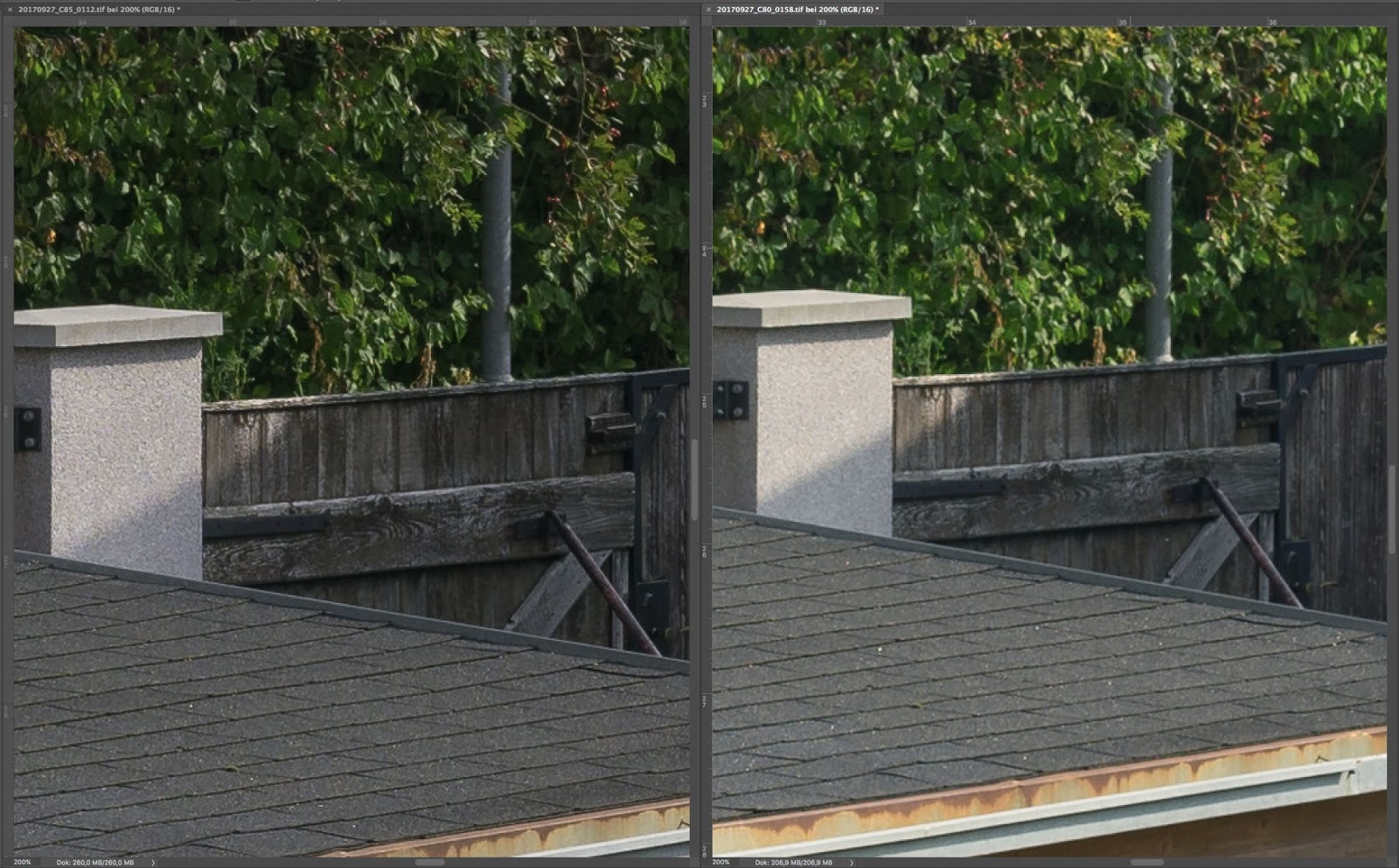
Warning!-this is pixel peeping at 200%
Both pictures are made with the Nikon 50 mm f1,8 lens @f8 from tripod and with mirror up. Left D850 with Iso 64 and electronic first curtain, right Nikon D800 with Iso 100. There is a small difference in resolution and dynamic range. With a zoom lens like the 24-120 it is less or not visible at all, with a "better" lens there might be a bigger difference (I do not own an Otus lens).
So why upgrade at all? I
already skipped the D810, although I got occasionally mild G.A.S.
symptons the last years.
It is an investment of at
least 4000.-€ (incl. tax here in Europe) as you have to buy a XQD
card and a card reader up front with this camera. I even tried to
argue me off this purchase. I failed, because a week ago I strolled
through a town here in Lower Austria. To my astonishment one of the
photo shops had the D850 on display. And when I phoned them three
days later the camera was still available, so I bought it. Seems like
here in Austria not so many photographers want to spend 4000.-€,
because the shops here don't get larger quantities than in the USA.
What tipped me over was
not a technical feature, like the good viewfinder, better AF or more
megapixel. It was realising that the attitude of „ I do not need
this, it does not matter which camera I use, any will do“, has a
psychological problem. Yes, for most of my projects 24 Mp will be
more than enough and yes most of my customers wont see any difference
with the pictures no matter what camera I use. If any one out there
thinks he gets more revenue, more customers with a new digital
camera, think twice.
But with photography it is
also like with music, you do not do it just for making money, you
also are linked to this art or craft, because for making money even a
job as a house cleaner would be better. If I would look at what I
earn per hour, I would kick myself. But photography is the only thing
which keeps me going, which is kicking my butt saying „get up, get
out, get some pictures“.
Buying such a camera is
for me a way to take my laziness out of me. It forces me to make new
projects, because buying such a camera and then just making a few
snapshots – no way!
So here are some excuses I
found so far to purchase it nevertheless:
The live view stream has a
better resolution, it was 640 pixels and is now 1024 pixels to match
the higher magnification of the rear screen, which helps if you do
studio work and use camera control pro, or the rear screen and a
magnification loupe. The split screen function is helpfull, but at
Nikon nobody seems to use the Tilt/Shift lenses, because it is still
not possible to look at the upper left and lower right corner in
split screen mode at the same time.
For checking sharpness
when you use the tilt of a lens like the 45mm TS the new focus
peaking function helps.
One good thing though is that now the 24mm TS lens rotates in both directions. With the D800/810 it was blocked by the bigger viewfinder/flash combo.
 |
| the less protruding viewfinder allows full rotation with the 24 mm TS lens |
The screen is now
tiltable, ok that´s good (I like and use the tiltable screen of the
D750 often), but anyone taking vertical pictures at Nikon? Fuji is
that doing right with the Xt-2.
The illuminated buttons
are nice to have, but only at the the left row. On the other hand even at night photography I still
need a red led lamp to see my surrounding or find pieces of equipment
in my bag.
The better AF and speed is
also a big improvement to my D800, I am looking forward to use that
on my next trip to Africa. But for the 9 frames/sec there is the need
of further investment in grip, battery and charger. Maybe the D500
might be the better investment for action or sport. Yes the D850 might be the best "allround camera" which can do anything from birds in flight to landscape or architecture. But there are situations where changing lenses (often) is not such a good thing to do and also a second body on longer trips is a wise thing to pack into your camera bag. So this D850 is not the "all in one solution" you might think. Also only the best lenses shine on the D850, this is certainly also the case with long telephoto lenses. So paired with a 600 mm f4 you get a dream team up to the moment you take your gear on board of an aircraft. Can you manage the 8kg weight restrictions or do you buy a second seat?
If you want to make the
best of this AF you have a steep learning curve up front. I can
recomend „Secrets of the Nikon AF System“ from Steve Perry. This
pdf has 467 pages! So much about digital makes photography easier.
He has also a good video
about the new AF fine tune feature. Which gets things into
perspective fast, because he shows that you should do 12 readings to
get a good average number. And you must center in Live View the AF
point, otherwise a cryptic Text shows up. It took me more than half
hour to find that I accidently switched the AF point in live view a
little bit. The fine tune numbers where sometimes quite consistent,
with other lenses like the Tokina Makro the readings were more
erratic, but at least it did not refuse to take a third party lens.
Af fine tune with one click? Sadly no!
Now checking the fine tune with a real furry animal, a teddy bear. What I found I did not like, because the numbers for my 300 mm f2,8 lens were simply said garbage. With the 1,4 Tc I had -17, but testing it with different numbers the best one was 0, or af fine tune set to "off". Seems like the af fine tune feature is very prone to (user) error.
Silent shooting mode
sounded great for me, but it is only available in live view mode. So
that means shooting with a 3800.-€ camera similar to a smartphone
(or as someone stated, you hold the camera away from you like a
smelly diaper). While you can adapt the viewfinder (diopter
adjustment) to your (poor) eyesight, not so for the rear screen,
which means you might need your glasses on and I am still not sure if
live view AF is useable in a dark church? But the screen with the
better resolution is really a big step forward and the touch screen
feature is great! Now all the menus are touch sensitive, which is a
good thing and speeds navigating in the menu. Certainly scrolling
through pictures is also much faster.
I was also very interested
in the so called „Best optical Viewfinder ever“ of the D850.
It is bright and certainly
better than the one in the D750, but as numbers suggest:
magnification of D810 is 0,70 with eyepoint 17 mm, the D850 has
increased that to 0,75 with also 17 mm eyepoint. Hey, great, an
increase of 0,05! Did Nikon really want to make the best optical
viewfinder or did they reduce cost by skipping the flash? I used the on board flash quite often for remote control of macro flash. With
the D850 I will need a commander module or dedicated flashes=extra
weight to carry.
I am beyond 50 and get
more and more problems with my eyesight, certainly a big bright
viewfinder helps. But also the size of the letters in the viewfinder
and the menu is interesting. Here nothing has changed, but it was
quite useable before.
Automated stacked shots
for macro looks good on paper, but with the app „helicon remote“
or even more versatile „qdslr-dashboard“ this was possible with
every Nikon Camera which had open Wifi. See the problem, the snap
bridge bluetooth/Wifi of the new Nikons is not allowing 3rd
party apps to function like before, its a more closed system with
very poor functionality.
Also to my big
disappointment this feature does not work with the Nikon 200 mm f4
Macro lens or my Tokina 100 mm f2,8 Macro, only AF-S or AF-P lenses
are supported. When I tried it manually I encountered a problem with
snap bridge (surprise?), in Live view there is no focus peaking on
the smartphone, live view on camera and releasing the shutter on the
snap bridge app does also not work. So back to the good old cable
release! Silent shutter does work, but without flash, it wont fire.
I tried a stacked shot with 30 frames. I use a mac
book pro retina with 16 GB Ram and 2,8 Ghz quad processor. Such a
task takes this computer to his limits, but he managed to do it. So I
do not think that this camera will force me to buy a new computer,
but it slows some tasks down like panoramas or stacked shots.
64 ISO, F8, 1/40 sec
A stack of 30 frames, manual mode with a Oben macro slider and the 100 mm f2,8 macro from Tokina. Silent shutter "1" shutter release via snap bridge app. Working very accurate would be good, as the processing on the computer took about 30 minutes. Every mistake means back to the start. Here I missed the opportunity to use the 4:5 Raw file option, which would have reduced file size. No need to record more of the black area.
Update 9.10.2017:
The time lapse features I
have checked at the weekend. It works good and the combination of silent shutter is a good thing. But because of the massive file sizes I will still use my D750 or even my Coolpix A for occasional time lapse recording. And it also makes me nervous to put a 5000.-€ Camera/lens combo alone out in the field. But the same here like with stacked shots.
Good if you are satisfied with the onboard tools, bad if you want to
do your own thing, because snap bridge again limits this. The
electronic shutter is certainly a good idea, because with heavy use
of timelapse you can get beyond the limit of the mechanical shutter.
When I buy a new camera one of the first tasks is to test it with all my lenses. I have to do this anyway once a year to check for any problems. This time I found my 16-35 mm f4 lens to underexpose 1 stop, a cheap repair at Nikon fixed the problem. What astonished me was that wide angle lenses like the 14-24 are much better in the corners on the D850 than on my D800 (all settings equal and shooting from a tripod). I have no explanation for this, but I take it as a bonus of the new sensor right now.
this is the left side of the picture, in the center both pictures look identical sharp and focus point was also the same, checked it a second time with similar results.
Today, 19.10.2017 Lightroom is supporting the D850. Before I downloaded the files into the dng format via Adobe Bridge. The dng files are about 10 MB per file smaller than the original losless compressed nef 14 bit and I can not see a difference in file quality so far. But it was a workaround and in the long run I prefer the original Nef files over the Adobe dng format. For comparing other Raw converters the Nef file is preferred. A side note: I tested Capture One and the files do have more "punch", but not because of some secret sauce. there are different profiles used, in C1 something more like a landscape profile, at Adobe the standard Profile is more flat. If you use the landscape profile in LR you get quite similar results to C1. And as a DAM Lightroom is still way better than C1. Changing software is like changing camera brands: Think twice about it. But testing C1 was actually a good idea, the different look brought new ideas which I now use with pictures in LR.

20 mm f1,8 @ f16, pulled out of a single shot, so no HDR
And now to the „new
guitar problem“:
Take a side step and
imagine you are a musician, a guitar player. You have a decent model
of an electric guitar. Now you have an offer for a guitar used and
played by Eric Clapton, or a new model with fantastic new whatever
advertised. Guess what, is there a guitar player out there who thinks
he will be a better player just with a new guitar? Yes, there will be
a lot of them, although they know that practising is way more
important. Some even stated that talent is overrated, because someone
who is practising like hell will beat the talented any time.
Disclaimer: I am not payed by anyone, so I can write freely what I like and what I do not like. And this is not a bashing of the D850, Nikon, or anyone out there. There are simply always things to find which work not as good as advertised. But after using the camera now for three weeks I can say it is the best camera I have ever owned
.
 |
| lots of light and conversion to black and white, no problem here for the D850. To be honest, the D750 would make a similar good picture. And who needs 45 MP for Facebook? |
Tested the D850 at a local concert of the band
"Monti Beton". This picture is made with 11400 ISO and turned out quite useable. The problem is that the modern LED lights on stage can have a "problematic" spectrum which leads to color artifacts.